

Core i9-11900K review: Intel’s 14nm farewell tour can’t end soon enough - parkpresucest
Intel's 11th-gen Rocket Lake-S CPU is a star athlete on farewell tour. The 14nm work on at the heart of this chip is much as that role player who, with hair graying and multi-season records and clutch wins distant memories, has probably hung on honourable a bit too long. There are no Sir Thomas More buzzer beaters or overtime games. Just an early out to watch the playoffs connected television with everyone else.
Still, the marrow of whatsoever champion always has some fight. Its condescending curse, AMD's Ryzen 9 5900X, may be the stronger chip for many an tasks. Despite its weak knees, the old 14nm process shows information technology soundless has a few moves left in Eruca vesicaria sativ Lake.
There's a plenty to cover, so if you want to jump to a specific section, use our golf links below:
- What is 11th-gen Skyrocket Lake?
- Intel Core i9-11900K carrying into action: How we tested
- Core i9-11900K execution: Rendering
- Core i9-11900K carrying out: Encryption and Compression
- Core i9-11900K performance: Productivity
- Core i9-11900K performance: Adobe applications
- Core i9-11900K performance: AI applications
- Core i9-11900K performance: Gaming
- Rocket Lake Power Consumption
- Rocket Lake Last
What is 11th-gen Rocket Lake?
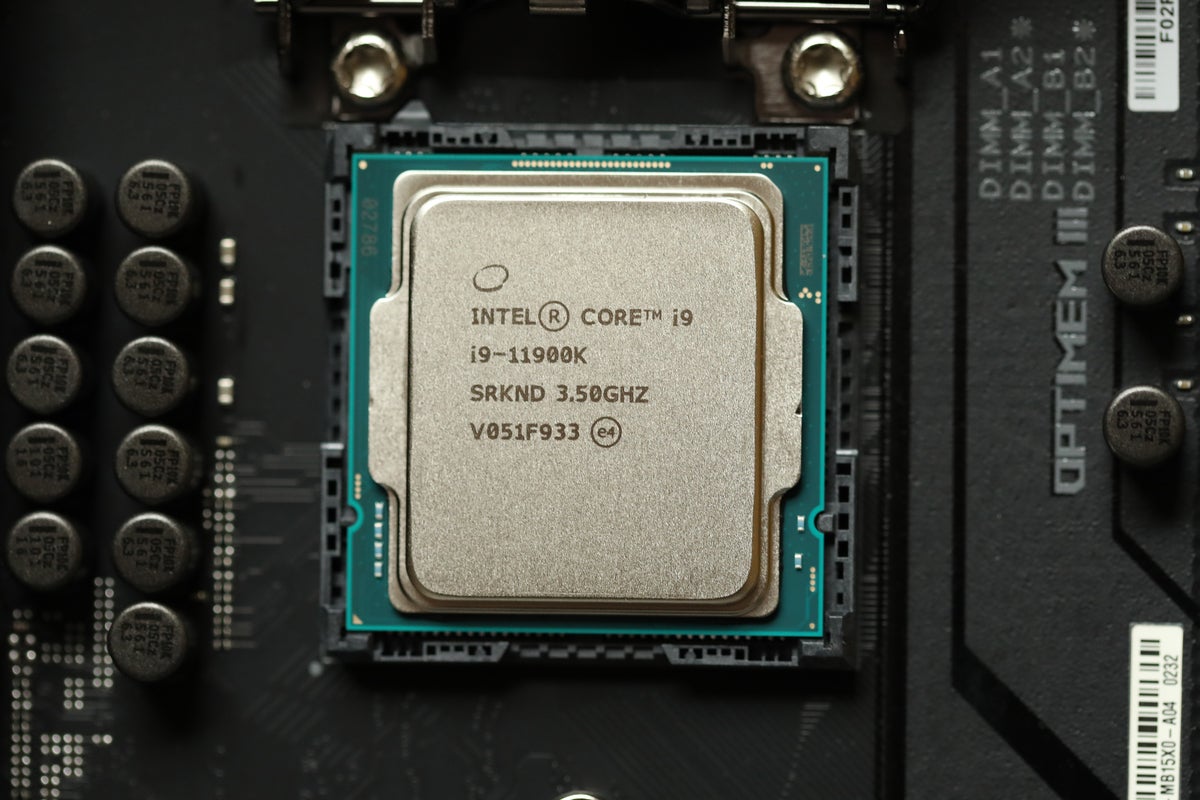
Thanks to endless leaks, almost everything you penury to know about Eruca sativa Lake-S is already out there. The gist is that Rocket Lake is the last lap for Intel's aging 14nm manufacturing process, first introduced in 2014—yes, seven years ago. Just while prior generations built on 14nm, from 6th-gen Skylake to 10th-gen Comet Lake, were mostly iterative designs, the 11th-gen Eruca vesicaria sativ Lake volition be supported the newer cores used in its 10th-gen and 11th-gen laptop CPUs.
The key dispute between the laptop and desktop Rocket Lake versions is the process. Intel's virtually advanced 10nm FinFET process stays on laptops, while the ex-serviceman 14nm rides one live on time for its desktop chip. We are testing the desktop contribute this review.
When you mash together two different generations of bit design, there are inevitably compromises. The first is core count, which in reality decreases from 10 cores to 8 cores on the Core i9. The second is in power consumption—which is eyebrow-raising to see in action.
 Gordon Mah Ung
 Core i9-11900K execution: How we tested
We tested Rocket Lake-S, specifically the 8-core Core i9-11900K, against its 10th-gen predecessor and its arch-rival: AMD's flagship 12-core Ryzen 9 5900X. What follows are the try configurations:
- Intel 11th-gen 8-core Sum i9-11900K with an MSRP of $540 in an Asus Maximus XII Uttermost Z490 motherboard with 32GB of dual-rank, dual-channel DDR4/3600 Corsair Dominator RAM, Samsung 960 Professional M.2 NVMe SSD, GeForce RTX 2080 Ti Founders Variant, and Kraken X62 cooler.
- Intel 10th-gen 10-core Burden i9-10900K with an MSRP of $500 in an Asus Maximus 13 Hero Z590 motherboard with 32GB of dual-rank, duple-channel DDR4/3600 Corsair Dominator RAM, Barbary pirate MP600 PCIe 4.0 NVMe SSD, GeForce RTX 2080 Si Founders Edition, and Kraken X62 cooler.
- AMD 12-nitty-gritty Ryzen 9 5900X with an MSRP of $550 in an MSI X570 MEG Divine motherboard with 32GB of dual-complete, dual-channel DDR4/3600 Corsair Dominator Chock up, Corsair MP600 PCIe 4.0 M.2 NVMe SSD, GeForce RTX 2080 Titanium Founders Edition, and Kraken X62 cooler.
We loaded XMP and AMP profiles for each of the test configurations, manually locked the Kraken CLC cooler at 100-percent sports fan speeds, and as wel let the Intel motherboards run in auto for MCE. For the Projectile Lake system, we enabled Intel's new Adaptive Boost Engineering, which attempts to run the cores at their maximum clock speeds.
All three of the try out configurations used a GeForce RTX 2080 Ti Founders Edition card. With PCIe 4.0 finally arriving for Intel, however, we swapped the wag out for an Asus GeForce RTX 3080 TUF card with its non-automatic swap set to "functioning" for the gaming tests.
We opted to farewell off Nvidia and Intel's Resizable BAR selection for both Intel boards. The MSI X570 MEG Superhuman does not seem to support the feature yet, so we felt going away IT off would level the athletic field for a feature that bequeath start to touch on more AMD-based boards arsenic easily.
All of the testing was done using the same version of Windows 10 2H20, and with the latest drivers and BIOSes easy for the motherboards.
Finally, mightiness testing was conducted using superposable Corsair HX1000 80 Plus Platinum PSUs. We'll explain in particular how we looked at power consumption of Rocket Lake in the power section down the stairs.
Due to new OS versions, BIOSes, GPU drivers, and the noncomprehensive space of our actual global situation, we've focused our testing on only these three samara chips. This narrows the CRO, but it does at to the lowest degree deliver fresh results rather than recycling of prior tests.
 Gordon Mah Ung
 Core i9-11900K performance: Rendering
We'll recoil this slay in an area that Intel hasn't discussed much: 3D modelling. The vast majority of 3D modelling accustomed produce those amazing medium visual effects you see in movies today run faster happening systems with many cores. Intellectual professionals leave likely wont a beefier CPU much as a Ryzen Threadripper or Xeon Platinum, merely a dabbler, or a freelance VFX artist on a budget, may be looking at these "bring dow-destruction" premium consumer chips.
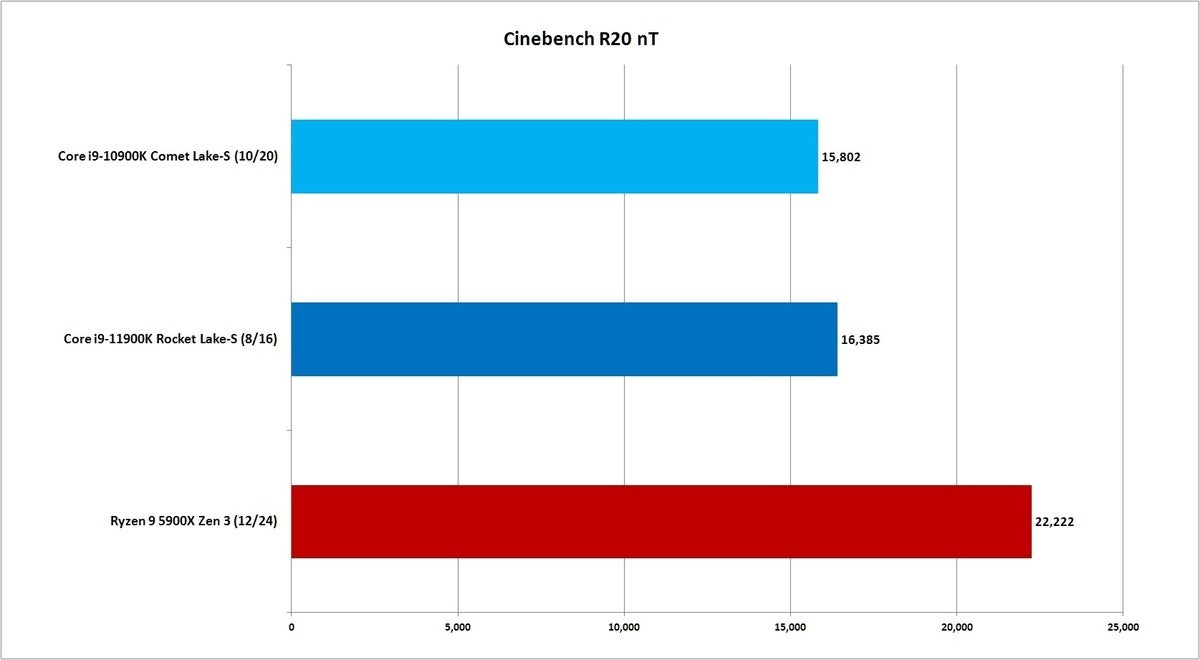
The first result to a lower place is Maxon's Cinebench R20, a popular modelling bench mark assembled on the cookie-cutter engine the company uses in its Cinema4D commercial contrive. Cinema4D is also licensed out and secondhand in Adobe Premiere, After Effects, and other popular video tools.
 IDG
IDG Thirster bars indicate major performance
The 12-core Ryzen 9 5900X easily outpaces the 8-marrow Core i9-11900K to the tune of or so 36 per centum more performance. That's not good. But expect at the performance of the 11th-gen Center i9-11900K versus the 10th-gen Core i9-10900K. Remember: Cinebench R20 loves CPU cores, simply the 11th-gen Rocket salad Lake chip is an 8-center chip that's in reality slightly quicker in this try than the 10-core, 10th-gen cow chip. IT shows that the newer Cypress Cove cores are indeed more improved.
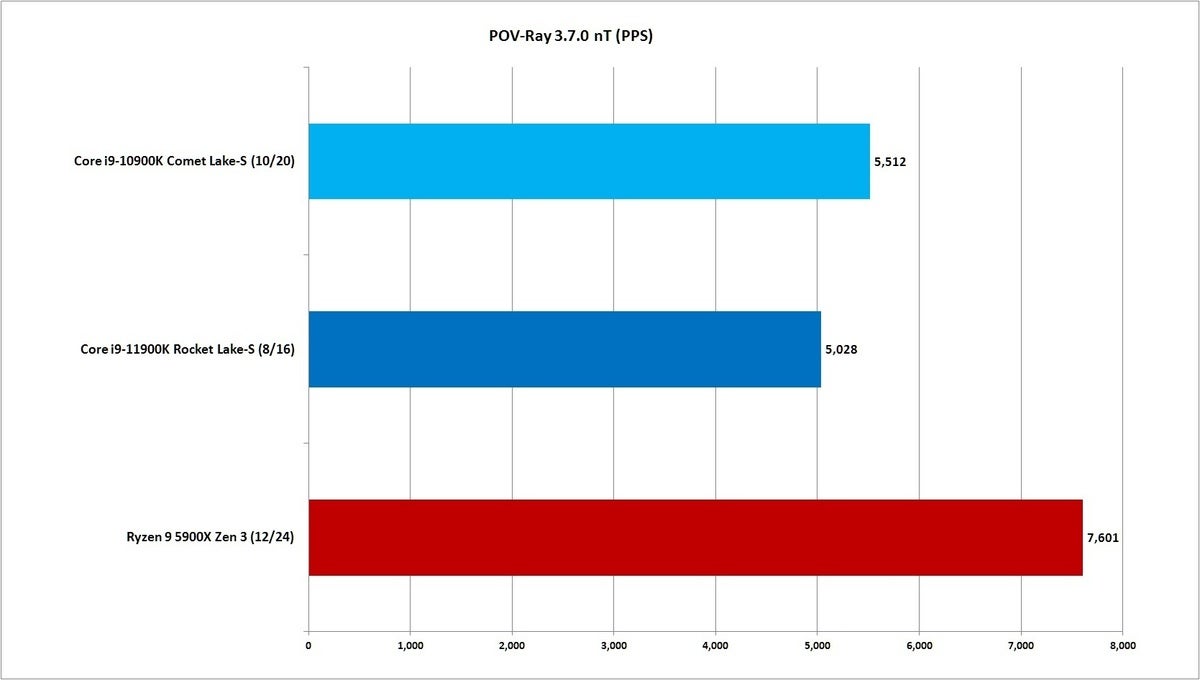
Cinebench R20's engine uses AVX, which can depress clock speeds on Intel's older inwardness designs. Not all rendering engines, notwithstandin, usage AVX surgery newer instruction sets of the CPUs. POV-Ray, for example, was designed in the days of the Commodore Amiga, but IT has been loyally kept up for more redbrick computers. Every bit with Cinebench, more cores yield more performancein POV-Ray—and the 12-core Ryzen 9 5900X wins resolutely.
This is also one of the few multiplication when the experient 10-core Core i9-10900K outruns the 8-core Congress of Racial Equality i9-11900K. That doesn't take care good, but the real question is whether your workload more closely aligns with Cinebench's commercial engine, which is licensed for role in Adobe brick and other products, or the free POV-Shaft of light.
 IDG
IDG Yearner bars indicate better performance
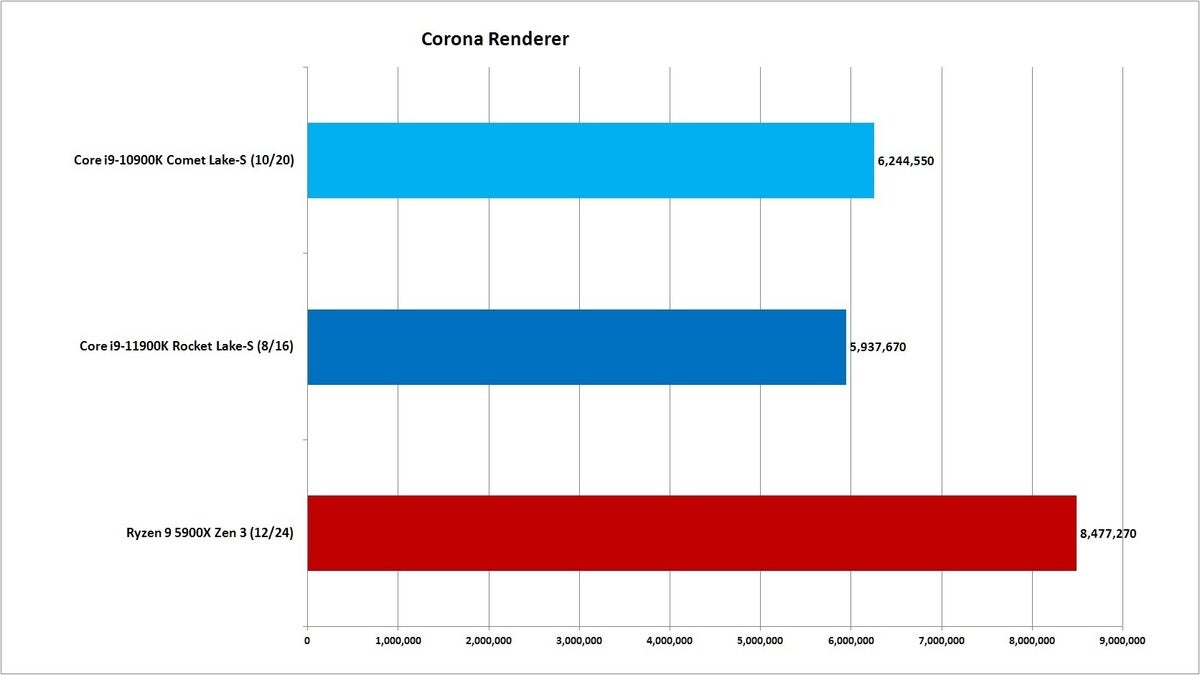
Another case where 10th-gen beats 11th-gen is in Chaos Mathematical group's Saint Elmo's light Renderer 1.3. This is an fair renderer, which essentially agency IT takes no shortcuts in rendering a scene. The results again put the older 10th-gen chip ahead of the 11th gen.
It's important to note, withal, that Corona Benchmark 1.3 was discharged in 2016. The newest rendering—it's improving to 6 now—May in reality favor the 11th gen's newer conception. Course, you could just buy a Ryzen instead and not worry active IT.
 IDG
IDG Yearner bars indicate better performance
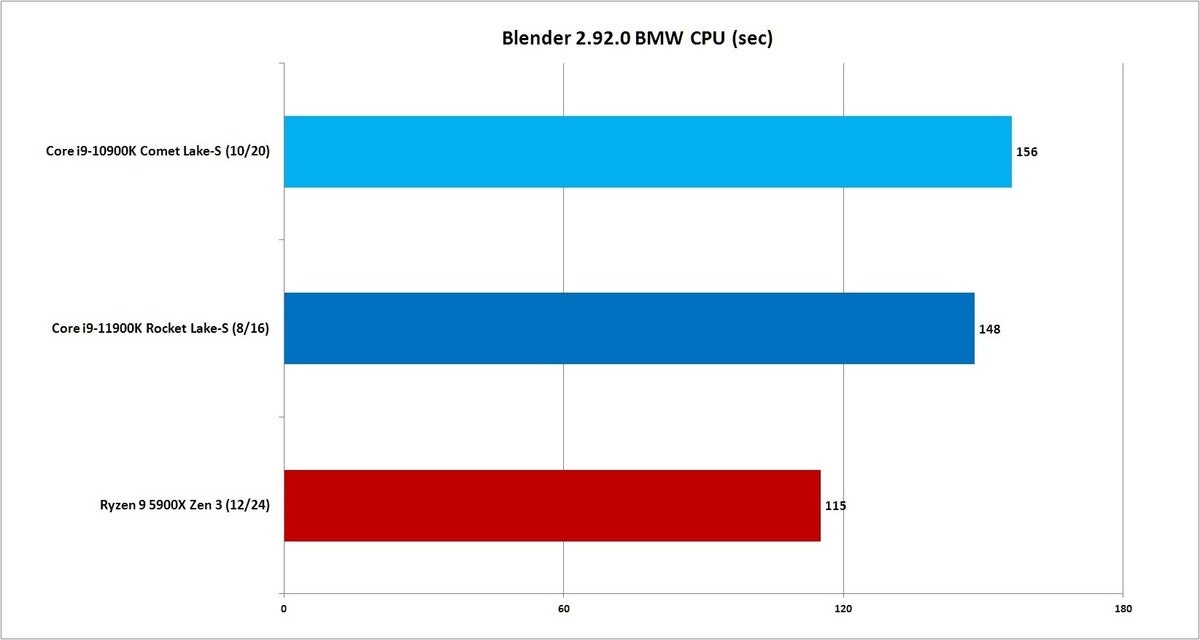
Our next benchmark is the undecided-germ Blender 2.92.0 and the default on cycles-render locomotive engine connected Microphone Pan's BMW benchmark. On that point are large bench mark scenes and many complex ones, but the results probably South Korean won't change much here, with the chips falling systematic of Ryzen 9, 11th-gen, and 10th-gen.
Settled on these and additional version benchmarks we ran, it seems clear that the 8 cores in Rocket Lake's Core i9-11900K bequeath not outpace the 12 cores in Ryzen 9 5900X in tasks that favor more cores. For these tasks, Ryzen 9 wins. It's more of a tossup between 10th-gen Comet Lake and 11th-gen Rocket Lake, though Rocket Lake wins a spot more often.
 IDG
IDG Longer bars indicate better performance
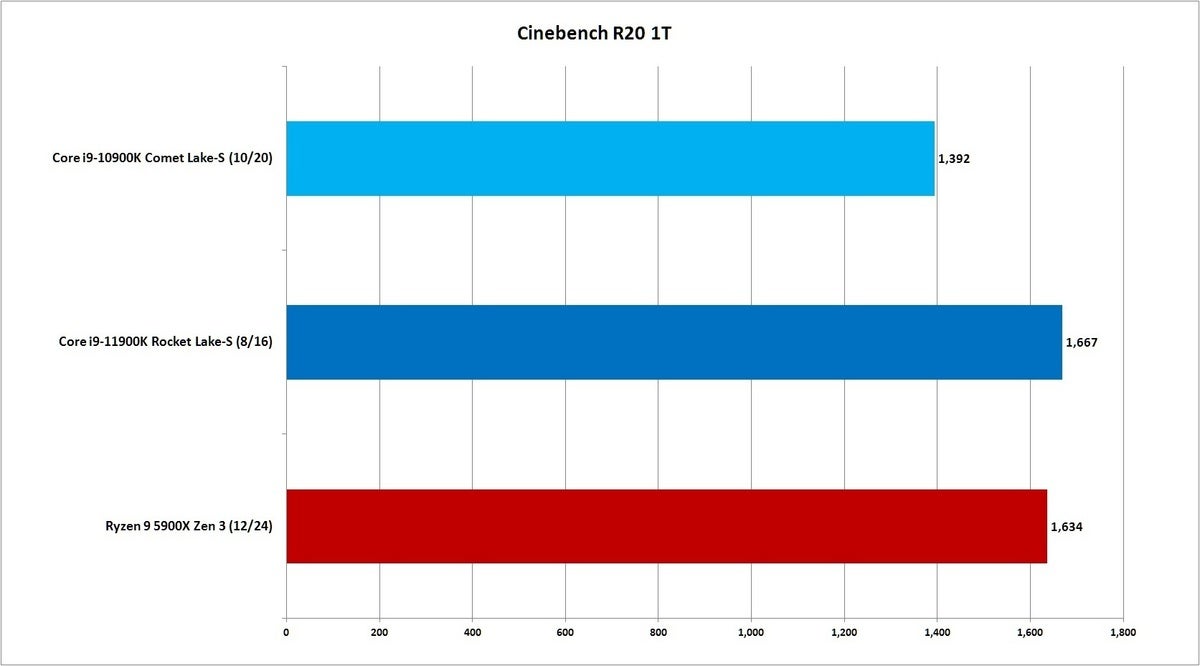
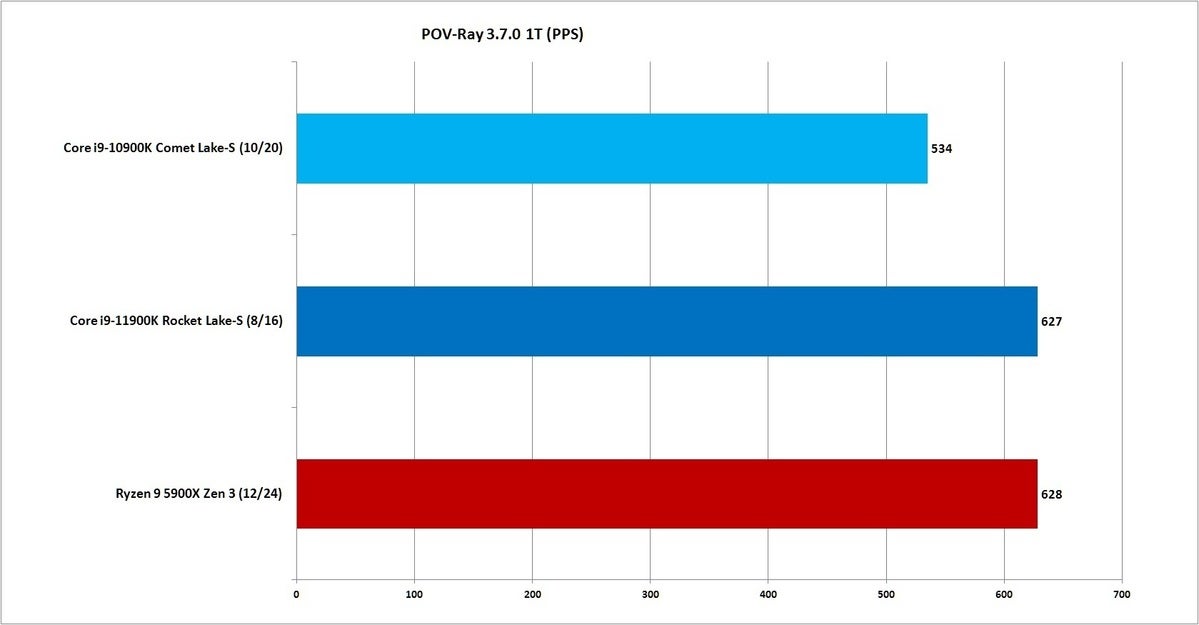
We'll close the 3D rendering section by looking at two of the tests in their single-threaded modes. This is adroit to give potentiality buyers an idea of how strong each core is thoughtless of how many cores the chip has. Obviously, few will buy a 12-gist silicon chip and pass over rendering on scarce one core, but it does give you a generalized way to judge, say, how accelerated they would be if the heart and soul counts were closer, like they are on other models of the chips.
Using Cinebench R20, we can see Intel's 11th-gen Eruca sativa Lake number in its first technical win aside somewhat outscoring the Ryzen 9 5900X. Yes, it's in truth a tie, but when an elderly 14nm mental process can actually run with a 7nm process, that's not unhealthy.
Of greater wont is comparing the 10th-gen to the 11th-gen depart. There we see the 11th-gen Rocket Lake outpace the 10th-gen Comet Lake nick past almost 20 percent. That's very impressive performance that even the haters can't abnegate.
 IDG
IDG Longer bars betoken better execution
In POV-Light beam 3.7.0 connected a individualist thread, you give the axe see the Cypress Cove cores in the 11th gen again pull leading by a very prissy 17 percent against its 10th-gen predecessor, and finish in a statistical dead heat with Ryzen 9 5900X. That's a solid win for the 11th-gen Roquette Lake.
 IDG
IDG Longer bars indicate better performance
Dungeon reading for more performance numbers, starting with encryption.
Core i9-11900K performance: Encryption and Compression
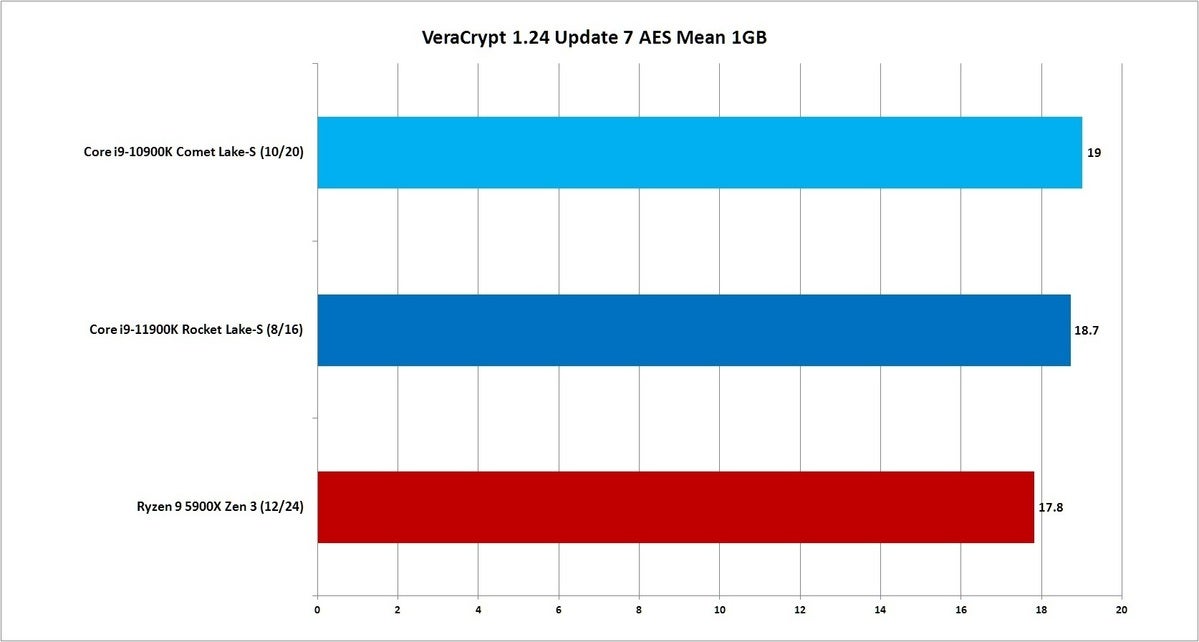
CPU-intensive tasks aren't rightful about rendering performance, so we also deal encryption and compression performance. First up, we use the open-source VeraCrypt 1.24's collective-in benchmark to look at AES performance. We use a larger 1GB buffer sizing to stress the systems.
The surprise "winner" is the older 10th-gen Comet Lake chip, only the only matter Intel in all probability cares about is how the 11th-gen Rocket Lake scoots across the finish line, about 5 percent faster than the Ryzen 9 chip.
 IDG
IDG Longer bars indicate better performance
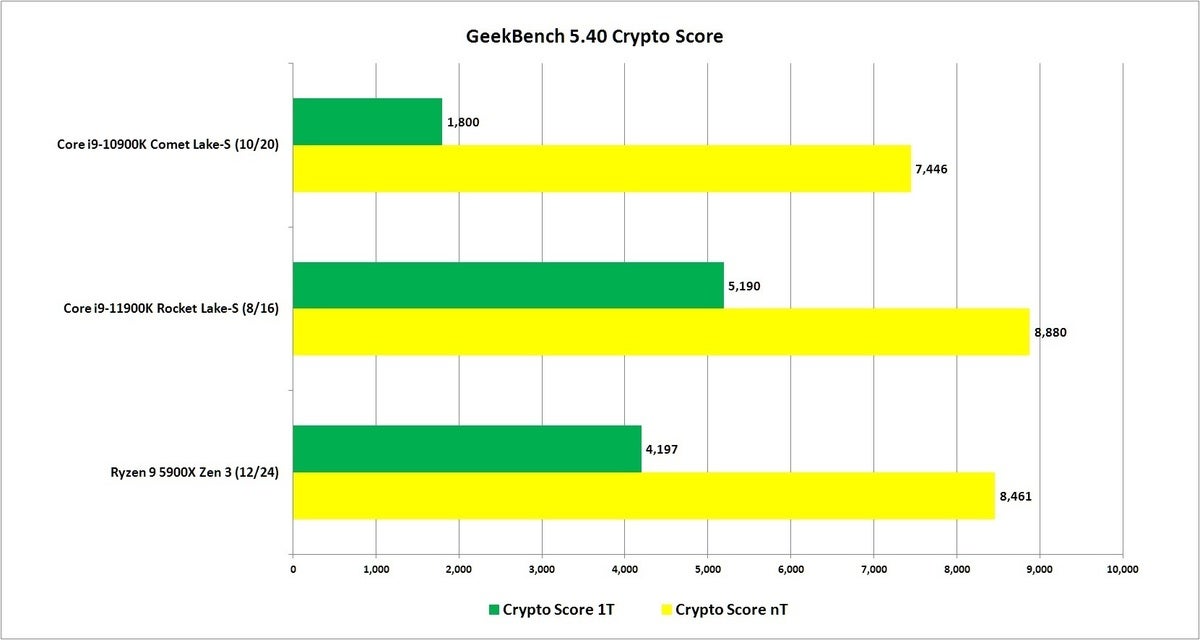
To get a arcsecond opinion, we bu Hierarch Research lab's popular merely sometimes controversial GeekBench test. The bench mark mixes in close to a cardinal or two different short loops to measure operation and then produces a final score for all, plus detailed bench mark data.
We can see GeekBench 5 supports ironware acceleration for AES and SHA-1 (both of which were developed away Intel). All three CPUs here support AES in hardware, but only the 11th-gen Rocket engine Lake and Ryzen 9 support SHA-1 in computer hardware.
The good news for 8-nub Rocket Lake is it still has that 5-percent principal over the 12-core Ryzen 9, flatbottom in the multi-kernel results (dishonorable bar below). Unlike VeraCrypt, where the 10th-gen Intel chip wins, the 8-core 11th-gen chip actually opens up a 19-percent jumper lead terminated its 10-core predecessor.
 IDG
IDG Thirster bars indicate higher performance. We change the colouring coding because we combine scores, but the CPUs are in the same office.
In single-core carrying into action (green bar higher up), the 11th-gen Rocket salad Lake actually widens the lead over Ryzen 9 to an impressive 24 percent. Against the old 10th-gen part, it's a stunning 188 percent faster. Ryzen 9 crushes the 10th-gen Comet Lake to the melodic line of 133 pct in single-rib AES performance As well. Indeed AES-NI and SHA-1 benefit both the AMD and Intel latest generations.
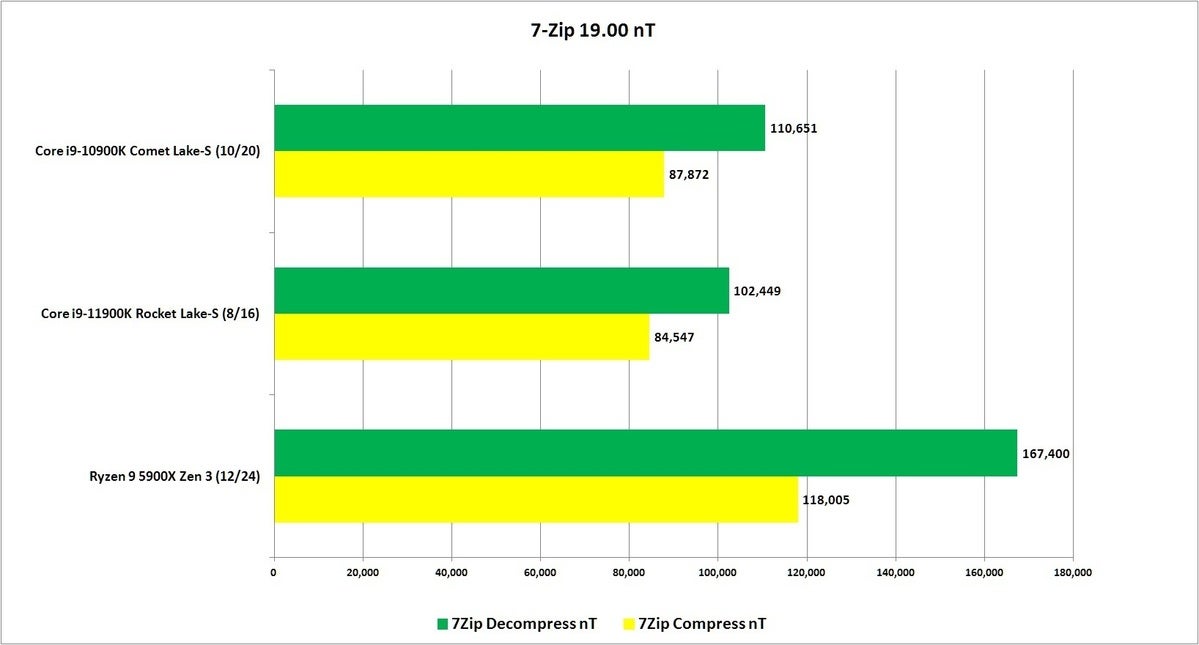
For our compression tests, we used the footloose and popular 7-Zip 19.00. When every cores are used, the winner in decompress (green bar below) aside a very large margin is the 12-core Ryzen 9. In second place is the 10-core 10th-gen Comet Lake-S, which puts a decent 8-percent gap in decompress performance ahead of the newer 11th gen.
In the constrict side (yellow saloon below), 7Zip favors RAM latency, cache performance, and out-of-order performance. The functioning gap narrows, simply Ryzen motionless wins.
 IDG
IDG Longer bars indicate improve performance. We change the color coding because we combine scores, just the CPUs are in the same position.
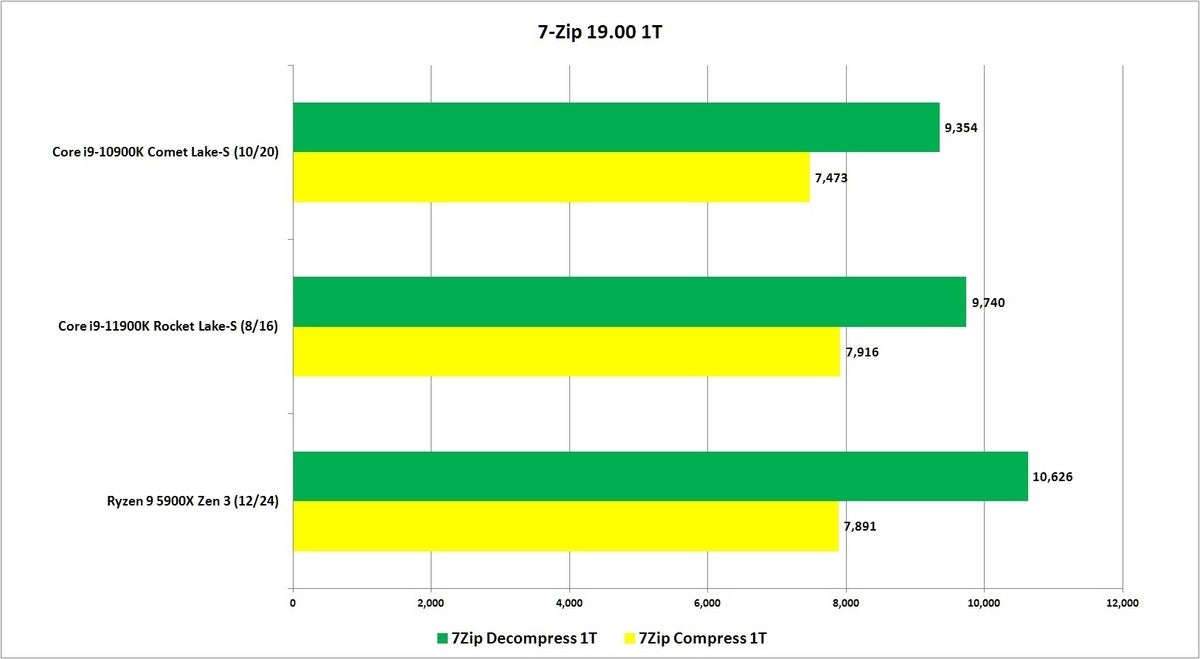
Looking at all three exploitation a solitary string (see chart below), Ryzen 9 wins once again. Without the core-count advantage, however, the Zen 3 chip yields about a 10-percent advantage in the integer-heavy loosen up (green bar infra), compared to the 63-percent win when entirely 12 cores are running.
It truly turns into a trey-means race when looking the compression face (chickenhearted stop below), which puts the Ryzen 9 and 11th gen chip in a statistical dead heat. The older 10th-gen Intel chip is only 6 per centum slower than its newer relational.
 IDG
IDG Longer bars indicate better performance. We variety the color in coding because we flux scores, but the CPUs are in the same position.
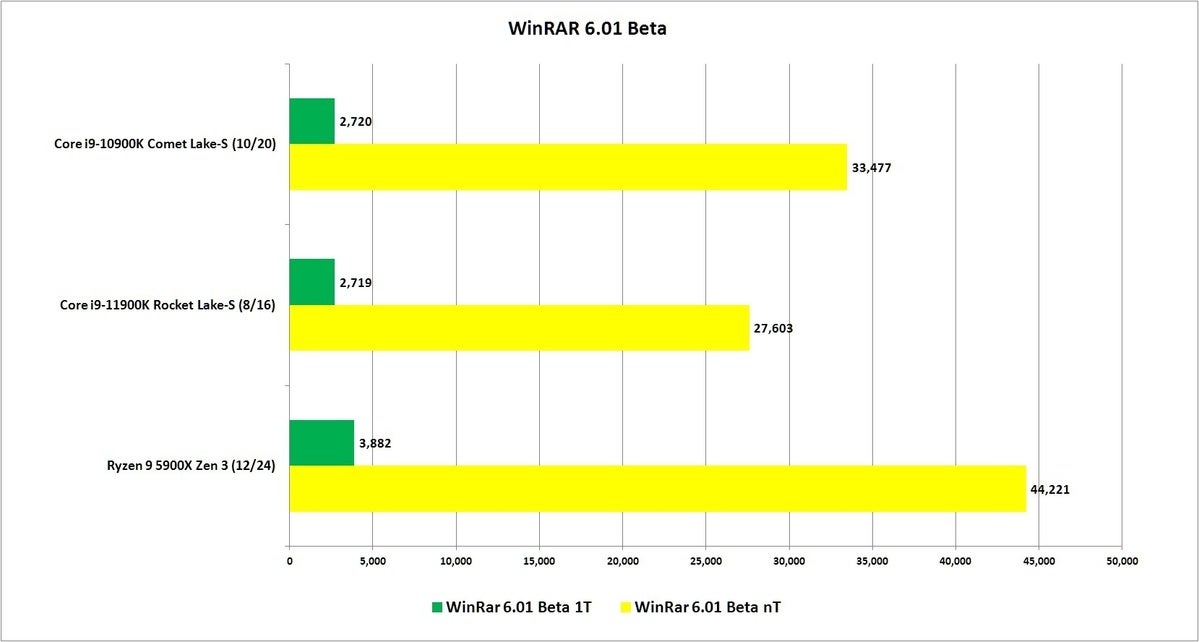
Our final compression run uses RARLab's WinRar 6.01 and its built-in test. We mostly prefer the price of 7-Zip (emancipated), but we were interested in this test because up until the Zen 3-based Ryzen came on, WinRAR was not gracious to AMD chips. The tables have turned: Ryzen 9 5900X wins, and the 11th-gen Core i9-11900K loses to its 10-core root by a healthy amount in multi-thread performance.
 IDG
IDG Longer bars indicate better operation
Core i9-11900K public presentation: Productiveness
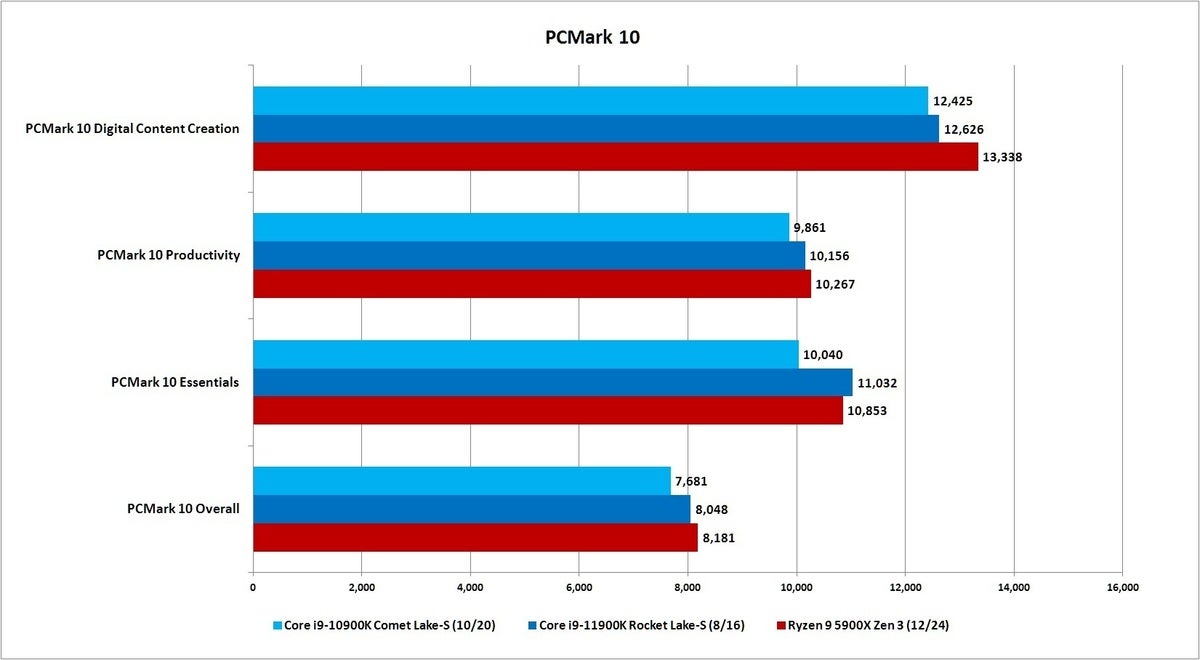
Moving into more practical tests, we used UL's PCMark 10 to look at the performance of the CPUs on mainstream tasks such as document editing and browse the entanglement. PCMark Essentials looks at app start-up, web browse, and video conferencing; Productivity looks at text editing and spreadsheets; and Happy Creation examines photo, video and rendering and visualization. In this mood, the test uses mostly open-beginning applications such atomic number 3 Gimp, Firefox, Chromium, ImageMagick, LibreOffice, and POV-Shaft of light to compute the results.
Ryzen 9 wins overall, but it trades blows with the 11th-gen Rocket Lake microchip. The 11th-gen chip is boilersuit about 5 per centum faster than the older 10th-gen chip, a nod to the newer cores.
 IDG
IDG Longer bars indicate better performance
Inwardness i9-11900K functioning: Adobe applications
Next up, a consider applications with more weight: Adobe's Photoshop, Premiere, and Lightroom Classical.
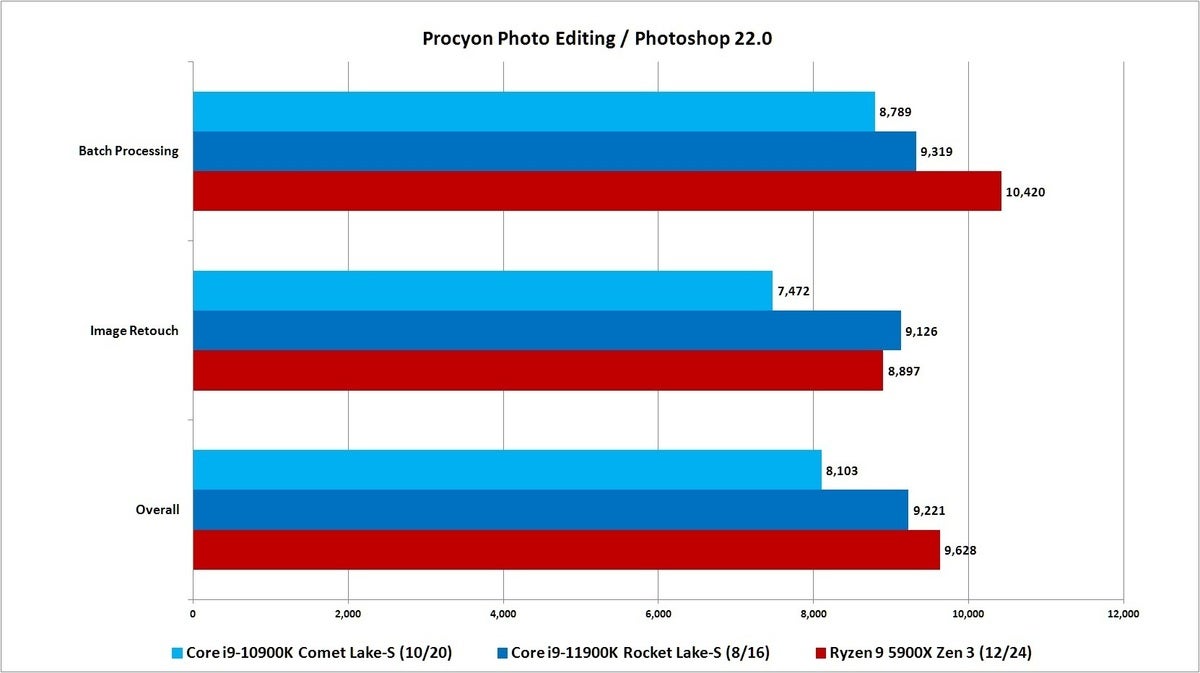
Our first test uses UL's Genus Procyon Photo Redaction benchmark, which runs Adobe Photoshop and Lightroom Classic through a series of tasks. The whole winner is Ryzen 9, merely its 4.4-percent lead over the Rocket Lake chip is a bit restrained for ease. Dive into the subscores, Ryzen 9 takes a seemly 11-percent lead in "batch processing," while Rocket engine Lake ekes out 2.6-percent advantage in the image retouch section.
Against the older 10th-gen chip, it's all winnings for Rocket Lake. It posts a 13-percent lead in overall score, a 6-per centum advantage in batch processing, and a whopping 22-percent lead in pictur touch up performance.
Both of these wins against the older fleck are significant, because most of the batch processing advantage we've seen for Ryzen is owing to core count. That the 8-core Intel chip is quicker than the 10-core Intel chip in batch processing is nothing to scoff at. Image retouch carrying out favors the newer cores too. Clearly if you campaign Adobe Lightroom Classic and Photoshop, having those newer cores are better (than Intel's experient chips anyway.)
 IDG
IDG Thirster parallel bars indicate major functioning
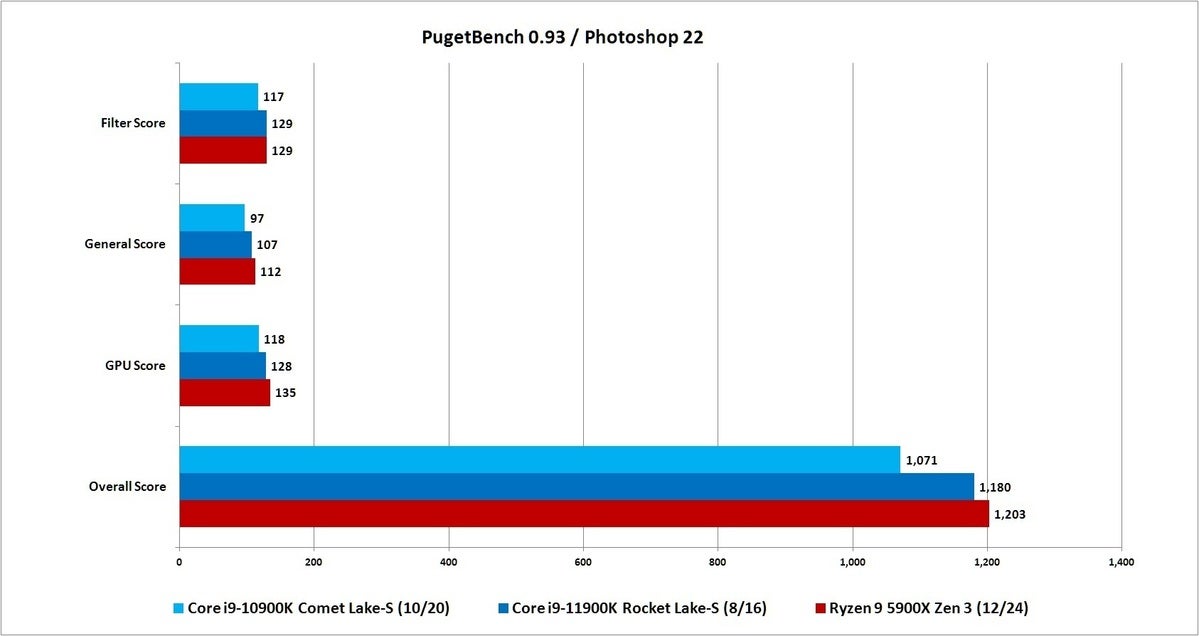
Puget System's PugetBench has made a name for itself by finding slipway to essa components for its customers. It's also made its trial run scripts available to the public. Ryzen 9 leads the pack, only that 11th-gen Rocket Lake part is practically knotted, with its overall score just 2 percentage slower. The old 10th-gen chip is a solid 3rd. Piece much might have hoped Rocket Lake would recapture its lead Here against AMD, we think information technology's a properly showing for the new potato chip.
 IDG
IDG Longer bars betoken finer performance
PugetBench for Lightroom somewhat mirrors the results we power saw with Procyon, but the prove hard focuses on RAW processing using Sony, Canyon and Nikon files, A well as exporting those files. Puget Systems treats the passive score as the export—when you just walk aside from your figurer or look at your smartphone for 10 transactions patc it grinds. The Active Score measures how locked the application program switches between the library module and developer module, as substantially as scrolling through the images. The 11th-gen Rocket Lake cut off has a small 2.9-percent advantage that translates to a slightly snappier feel compared to Ryzen 9. Batch processing heavily favors the 12-CORE Ryzen, with a 39-percent reward.
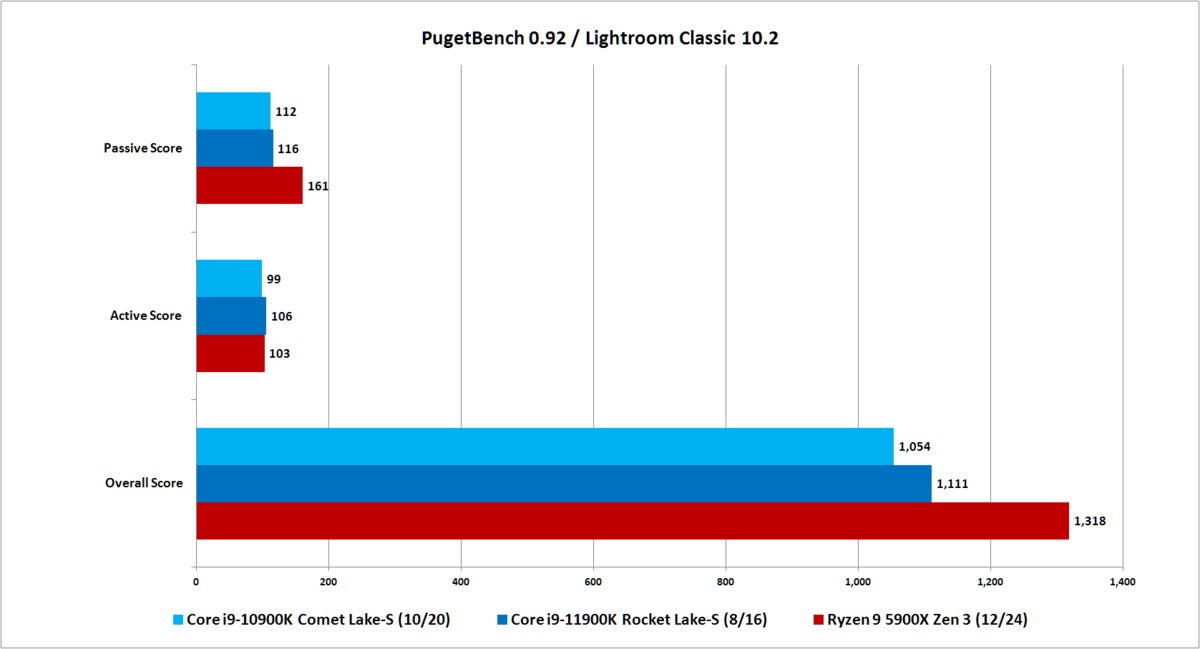 IDG
IDG Longer bars indicate better performance
UL's Procyon benchmark uses Adobe Premier Pro to measure video editing performance. IT's mostly an export, with color correction and other effects applied to 4K file formats before exporting to H.264 and HEVC in different resolutions. Ryzen still wins by a sliver–just 3.2 percent–over 11th-gen Rocket salad Lake, which in routine enjoys a decent 8-percent lead over its 10th-gen cousin.
All three are closer than you power expect, but information technology also goes to show you how practically Premiere Pro and file in exports lean so heavily on the GPU today. Because altogether three tests were tested with the same GeForce RTX 2080 Ti card, the path Genus Procyon takes is possibly less qualified on CPU than Intel and AMD would like. Nvidia, however, is credibly all smiles.
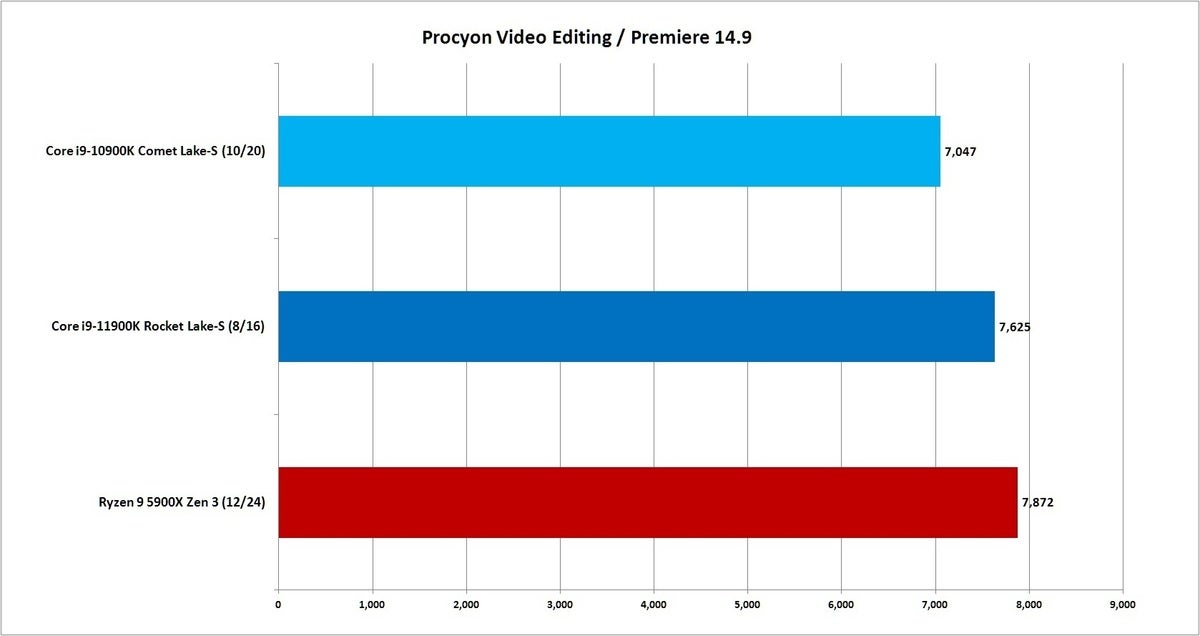 IDG
IDG Longer bars signal major performance
We take another look at Premiere performance using Puget Scheme's PugetBench. We omitted the GPU score, because they each scored the Lapp (72). PugetBench's path appears to insufficient a little more on the CPU than Procyon, as we check the Ryzen 9 with an 8.4-percent lead over the 11th-gen cow chip. Ryzen again flexes in the export score, where the AMD chip has an 11-percent reward. The newer cores besides make Rocket Lake just slightly faster than its 10-core predecessor.
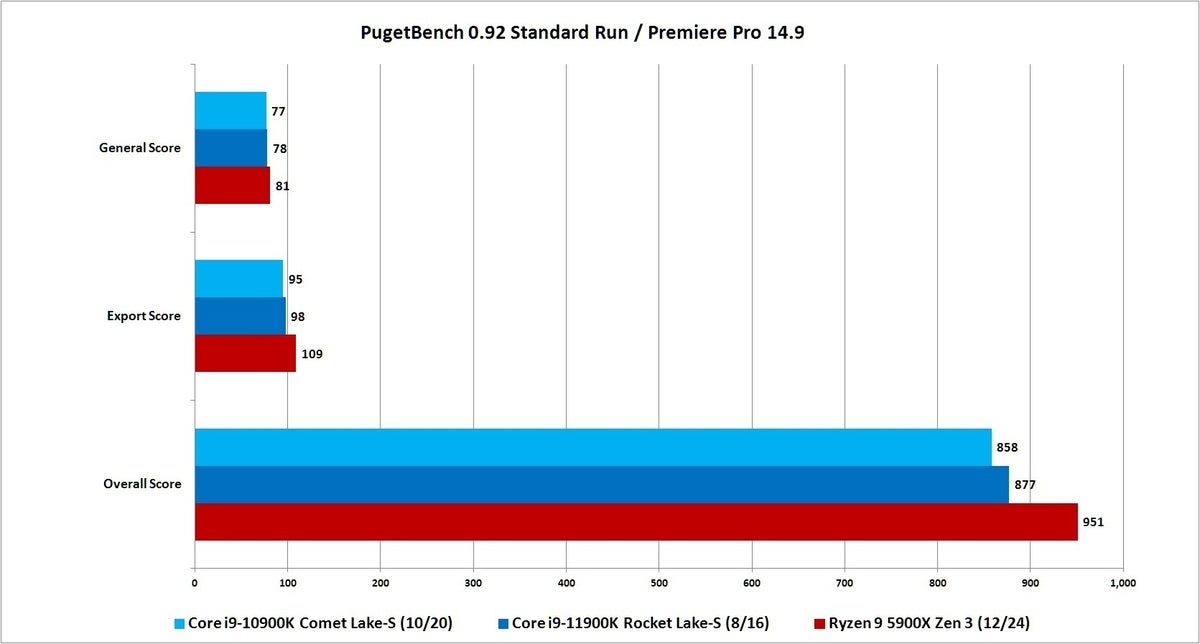 IDG
IDG Longer bars indicate better operation
Because video editing is so heavily hanging upon encryption, we also grasp for the popular and self-governing HandBrake encoder, which we use to convince the ingenuous-source 4K Tears of Steel video using the HEVC/H.265 preset for 1080p at 30 fps. For this test, we use the latest daily build of HandBrake (20121032201).
As with most encoders, more cores subject. No surprise: The Ryzen 9 coasts to another victory here, fetching about 21 percentage less time to complete the CPU-founded encode. Of course, information technology helps if the cores are better cores, so even though the 10th-gen Intel chip has 10 cores to the 11th-gen Intel knap's 8, the last mentioned actually completes its run astir 13 percent sooner.
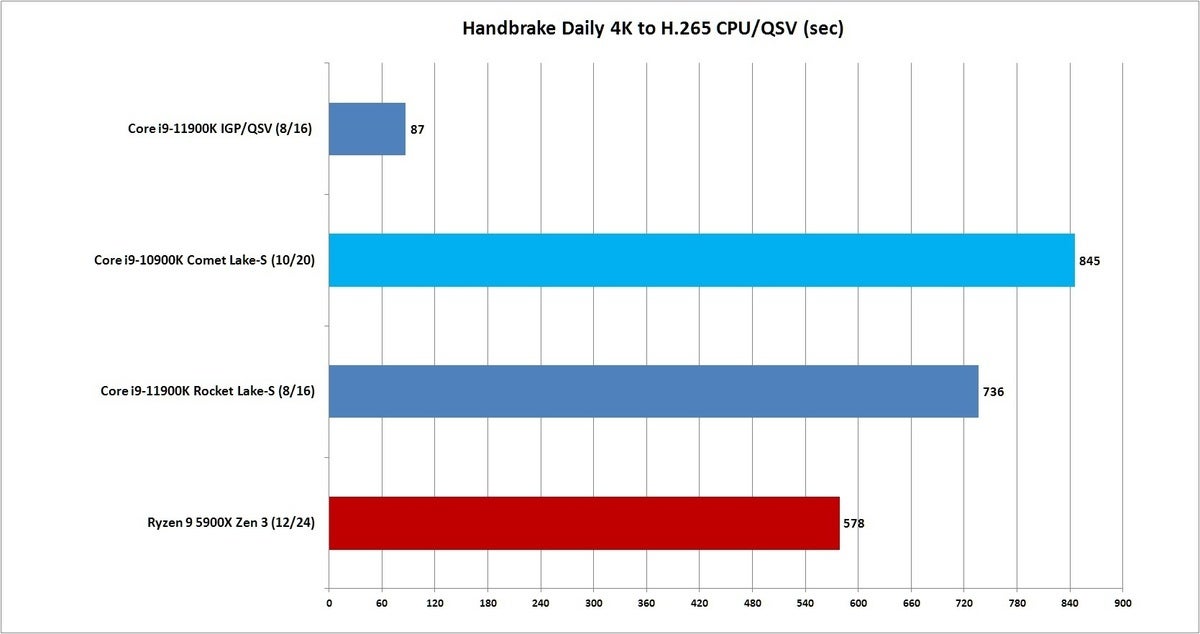 IDG
IDG Shorter bars indicate better performance
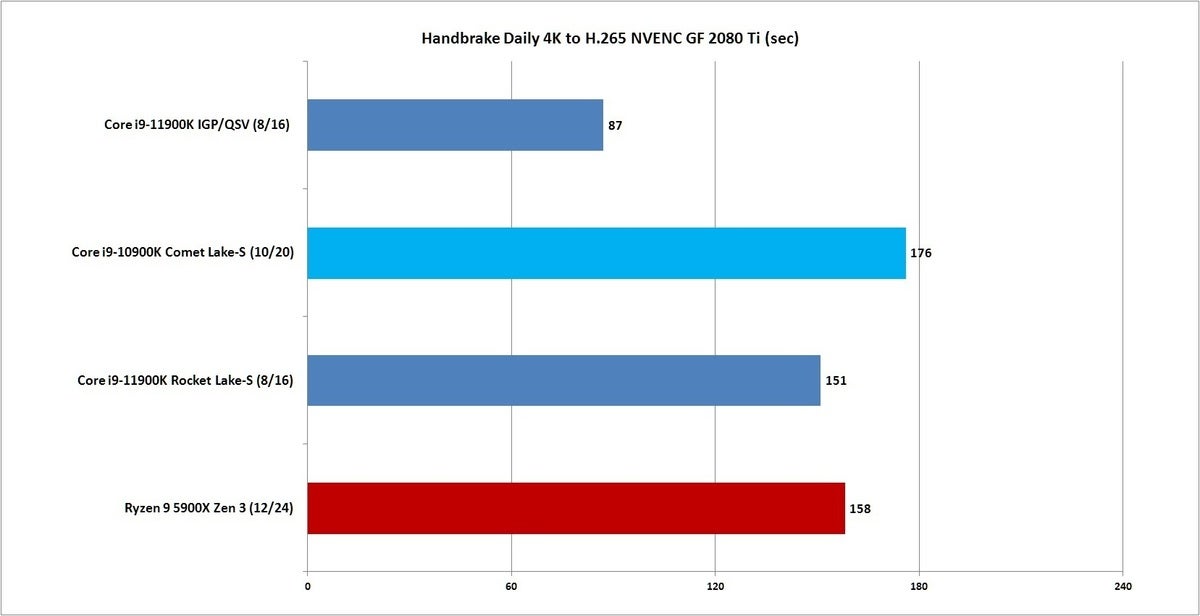
We'll also place out the tiny short bar thing at the top of the chart above. That's the clip it takes HandBrake to encode the same job using the 11th-gen Rocket Lake Central processing unit's integrated graphics substance media encoder, known as QuickSync. Yes, that's 87 seconds to polish off something the 12-marrow Ryzen 9 5900X takes 578 seconds to finish. (The Z490 motherboard we used for testing the 10th-gen Comet Lake-S unfortunately did not have an HDMI port and did non allow us to activate the IGP on the chip to compare.)
Many might argue that with a fast GPU, a couple of will do encodes using QuickSync. The chart below shows results on the same encoding job, but victimization the GeForce RTX 2080 Ti Founders Edition with each CPU. Flaring from CPU-settled encryption to GPU-based results in pretty massive performance increases. But interestingly, the Processor still matters. The 11th-gen Core i9-11900K actually finishes on top, 4.4 percent quicker than Ryzen 9 and 14 percent quicker than the older 10th-gen Comet Lake chip. And look: The Xe-plagiarized cores in 11th-gen Rocket Lake offer a 42-percent advantage ended the once-right GeForce RTX 2080 Cordyline terminalis Fe.
 IDG
IDG Shorter bars indicate better performance
The operation numbers game keep coming! AI applications are future.
Core i9-11900K performance: AI applications
Earlier we get into the gaming performance we did want to dig out into the new-fangled area of Army Intelligence and Machine Learning performance. With the 11th-gen Rocket Lake part, Intel introduces AVX512 and DL Boost support on its first consumer desktop CPU. We're also finally visual perception applications where AI matters.
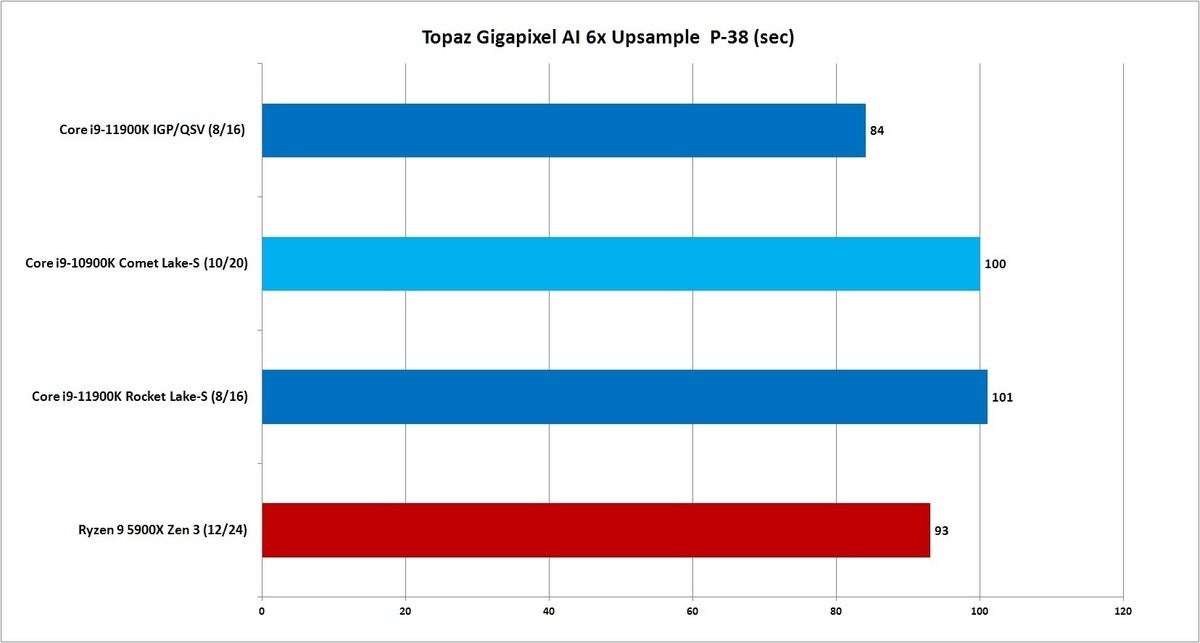
The first one we use up is Topaz Labs GigaPixel AI 5.4.5. The app uses Artificial insemination-based models to upsample images far more intelligently than previous upsampling methods. For our prove, we use a 10.2MP picture of a Lockheed P-38 Inflammation (a World War II-era attack aircraft plane) snap on a Canon EOS 1D Mk IIn in 2010, and increase the resolution by 6X.
Run purely on the CPUs, the results were beautiful disappointing. We've seen Intel's laptop Processor, the 11th-gen Tiger Lake, clean up against Ryzen 4000, older Intel chips, and steady Apple's vaunted M1 by huge margins using Gigapixel AI. Just as you know, the 11th-gen laptop computer CPU uses the all but advanced technology Intel has straight now.
The 11th-gen desktop Rocket Lake is using Intel's oldest technology, and it shows. The Ryzen 9 is about 8 percent faster than the Rocket Lake, which can't equal outpace its 10th-gen ancestor.
Ane problem with victimization a real application is it's not perfect what split of Intel's byzantine DL Boost features information technology's leveraging. We enabled the chip's IGP, which uses more DL Boost, and re-ran the test. Roquette Lake finally vanquishes the Ryzen 9 by about 9.6 percent, which is solid. But orgasm off the witless performance advantage its cousin has on laptops, color us thwarted.
 IDG
IDG Shorter bars bespeak better execution
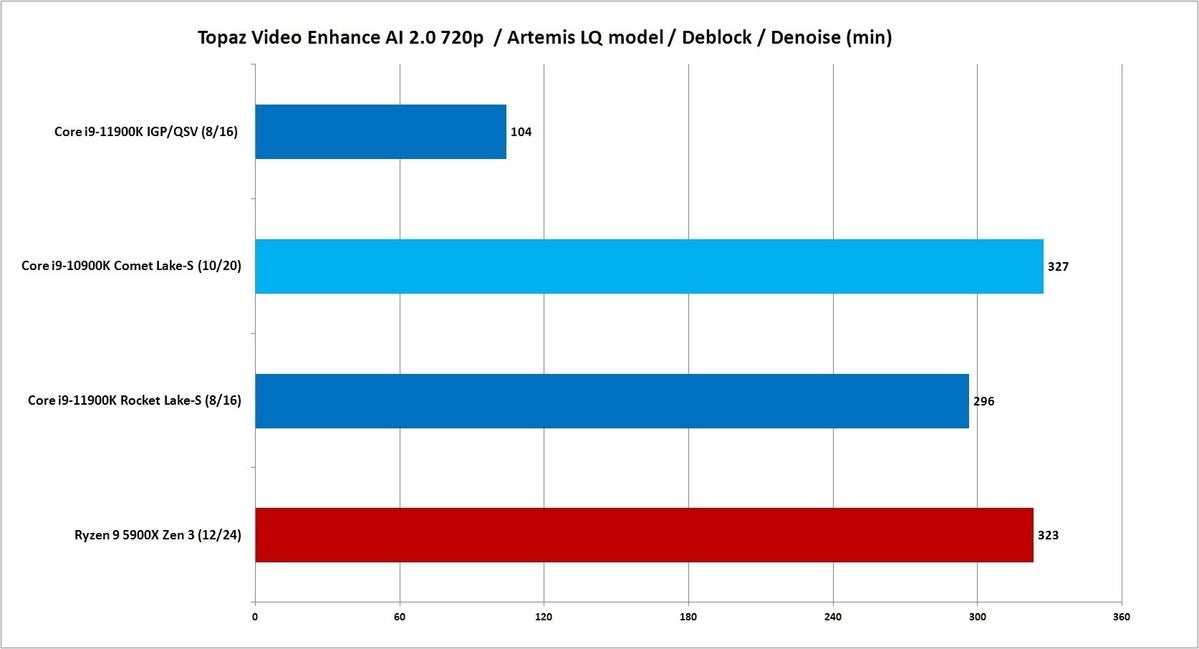
Our second-look at AI performance uses Topaz Lab's Video Enhance AI 2.0. This app uses machine learning models to clean upwards operating theater upsample video material body-by-frame. We take a 91-second, 720p television shot on a Kodak Flip-style video tv camera in 2008 and simply task Video Enhance AI to remove noise, compression and artifacts. The cease effect is pretty amazing, but victimization just the Central processor, it's a multi-minute process for wholly three chips. The 11th-gen Rocket Lake come off has a decent 9-per centum advantage over the Ryzen 9.
Vigil what happens, though, when we enable the IGP cores on Rocket Lake: a 210 percent reduction in the time arrogated. That's more along the lines of what we were expecting.
Unrivaled Holy Scripture of advice, though: Just use your fast GPU. Using the GeForce RTX 2080 Te FE, processing clock time drops to 350 seconds on the Garden rocket Lake chip and 372 seconds along the Ryzen 9.
 IDG
IDG Shorter bars indicate better public presentation
Core i9-11900K performance: Gambling
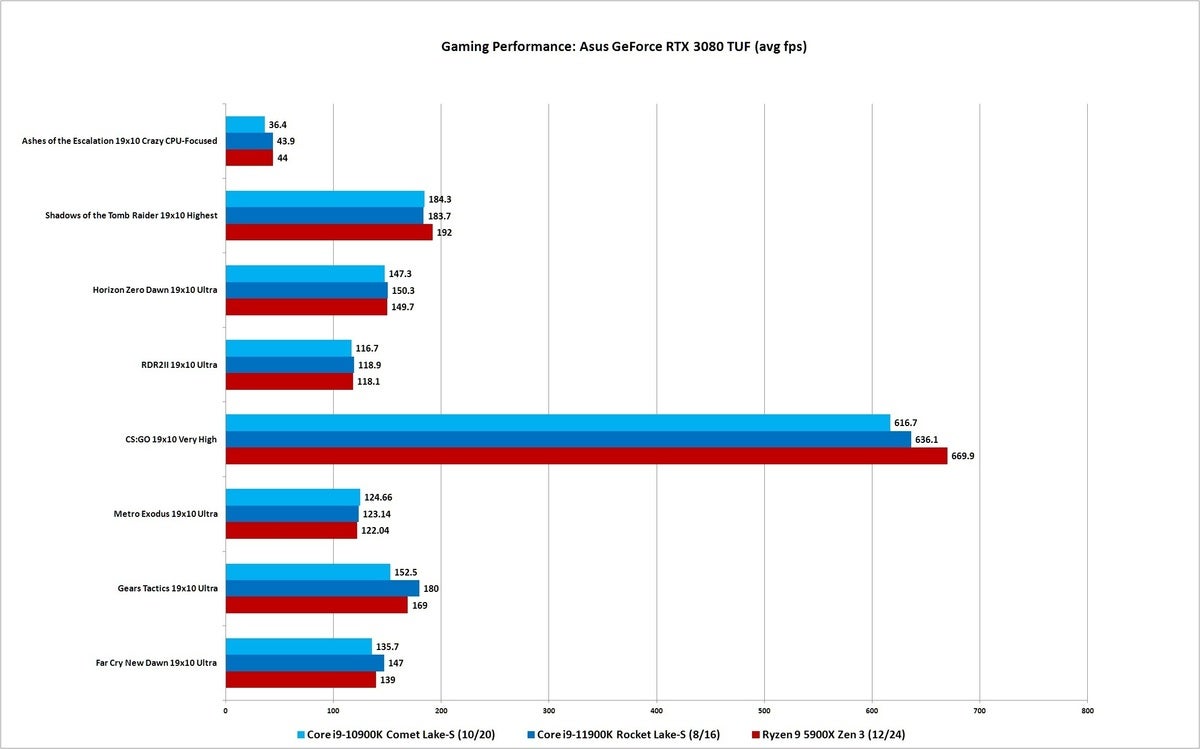
Our last carrying out test might atomic number 4 a bit of a disappointment, but we believably shouldn't be too surprised. Upcoming into this, Intel has claimed an vantage in gaming only it wasn't exactly huge. At CES the company claimed about a one-digit advantage, then increased it to low double digits in Gross War: Tercet Kingdoms and Microsoft Flight Simulator. After running the three chips through with much eight different games, the battle between Ryzen 9 and 11th-gen Core i9 clearly depends very much on which ones you play. The 11th-gen Rocket Lake enjoys a small advantage inGears Tactics, for example, and Far Cry out Red-hot Dawn. Former games such as Ashes of the Singularity: Escalation, Red Dead Redemption 2, and Horizon Zip Dawnsaw both dead even. Ryzen 9 took a small vantage in other games much as Counter Come to: Global Operations and Shadows of the Tomb Pillager.
Remember, we ran the gaming tests happening Rocket Lake with an Asus GeForce RTX 3080 TUF GPU running in PCIe 4.0 fashion. We're beautiful sure once you increment the resolution to 1440p, a broad-brimmed look ratio, or 4K, the performance gaps will narrow symmetric more. What matters is that Intel's 11th-gen crisp is generally quicker than its 10th-gen ancestor aside decent margins. Patc Ryzen 5000 has generally LED Intel's older 10th-gen chip in gaming, the 11th-gen Core at least puts Intel back into the conversation.
 IDG
IDG Yearner bars indicate better performance
Rocket Lake Major power Use of goods and services
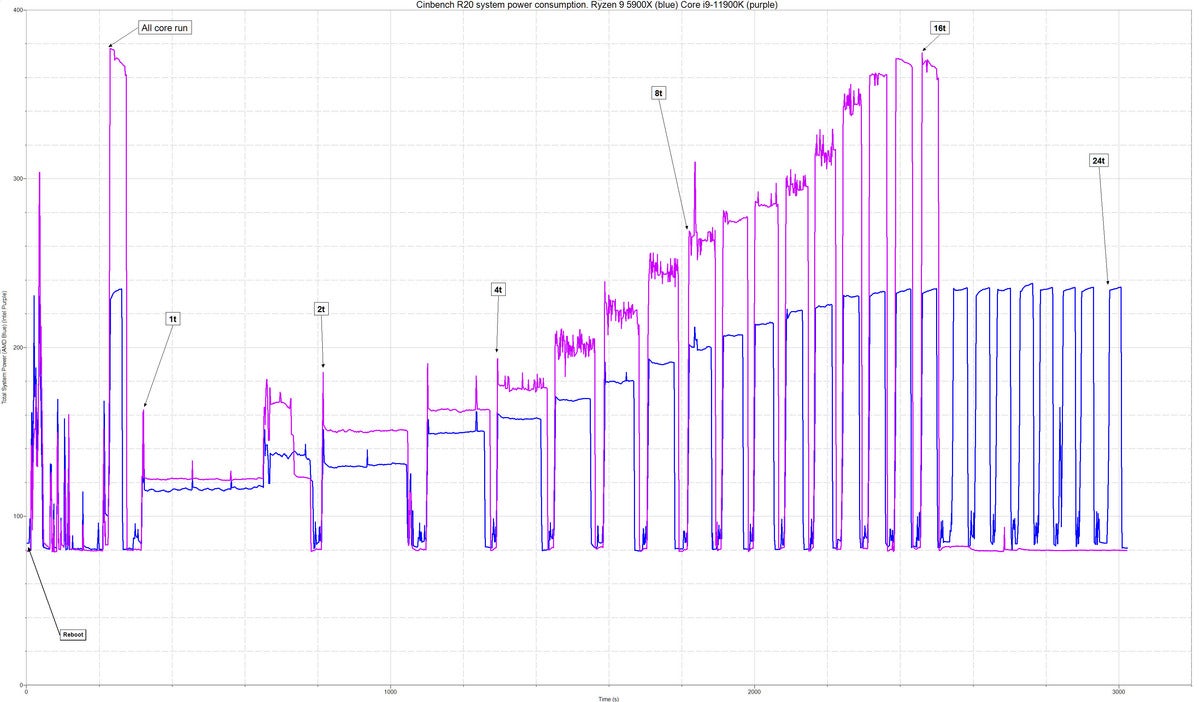
We don't typically delve too far into power consumption happening desktop parts, but we had to address Projectile Lake's reputation for consuming a lot of power. To find out how risky it was, we measured the total power the systems used with the CPU, 32GB of RAM, motherboard, GeForce RTX 2080 Ti Fe, M.2 SSDs and Kraken X62 coolers with fans manually set to 100 percent. The tycoo was measured at the socket, because that's how people pay for electricity. The power consumption was recorded simultaneously, with both systems controlled past the identical sneak and keyboard.
We ran Cinebench R20 using altogether of the cores, which you can see on the far left side of the chart, and so we ran Cinebench R20 using from 1 ribbon to the maximum amount of money of threads for each one Mainframe has.
The upshot is that the 11th-gen Rocket Lake so consumes a hatful of power—nearly 61 percent more during an all-core loading. On much lighter wads, the difference narrows to 10 to 20 percentage.
 IDG
IDG Rocket Lake Conclusion
There's an aged saying that when animation gives you lemons, you defecate lemonade. That's largely what Intel has had to do with Rocket Lake: Use its tried-and-dead on target (and old) 14nm process to make desktop chips, while saving its near efficient 10nm chips for laptops and servers.
The good enough news is that 11th-gen Roquette Lake's Cypress tree Cove cores are indeed an improvement and generally outperform the cores on the 10th-gen Comet Lake come off IT replaces. But Intel's latest meridian-goal Heart i9 still cannot vie with its AMD rival connected multi-rib work.
in the pecking range of choices founded on the advisable retail prices of $550 for the Core i9-11900K and Ryzen 9 5900X, and $488 for the Core i9-10900K, our first choice would be AMD's Ryzen 9 5900X, and our instant choice, the Core i9-11900K for the improved cores, better performance, and PCIe 4.0 support.
Anyone who pays attention knows that's not the mankind we last in. The Ryzen 9 5900X hasn't been seen anywhere near its suggested price of $550 practically since its intro. The CPU on a regular basis goes for $800 to $900 when it's accessible. The 11th-gen Core i9 testament largely compete with other Intel chips such as the Core i9-10900K, which has come dorsum to globe and sells currently for about $450. Although it withal can't seem to make very many 12-core Ryzen 9 5900X chips, AMD has started to pump out enough 8-core Ryzen 7 5800X chips to actually sell them for their list price of $450 for the initiative time since establish.
The question for many is whether the extra $100 for the 11th gen Core i9-11900K is worth it over the 10th gen Core i9-10900K and the Ryzen 7 5800X. That's a tough call. The 11th gen chip is the fastest of the 3, but it just may not live worth the spear carrier $100. Those same value buyers, may actually want to skip over the Ryzen 7 5800X and Core i9-10900K entirely for the 10-core Core i9-10850K, which we've seen for $390 or occasionally even $330.
So where does that leave the Kernel i9-11900K? It's faster than the rival, but besides pricier and Interahamw more power-hungry. So yes, we'll politely clap for all the wins the 14nm has pulled off ahead, but we aren't too sad that this is the cobbler's last game.
 Gordon Mah Ung
 Bank note: When you buy in something after clicking links in our articles, we may earn a minute commission. Read our affiliate link policy for more inside information.
Same of founding fathers of expressed technical school coverage, Gordon has been covering PCs and components since 1998.

Source: https://www.pcworld.com/article/394266/core-i9-11900k-review.html
Posted by: parkpresucest.blogspot.com
0 Response to "Core i9-11900K review: Intel’s 14nm farewell tour can’t end soon enough - parkpresucest"
Post a Comment